








The good, the so-so and the also-rans in global alcobev awards competitions
The alcobev world swims in an ocean of awards of every shape, nationality and hue. There are awards for spirits, wine, beer, as well as non-alcoholic beverages. There are specific awards for individual types of alcohol. There are awards with expert juries, and others that pride themselves on having a consumer jury. What unites all brands across the world is that they all love to get one!
Nothing pleases the human heart more than the joy of climbing onto a stage to collect an award and be applauded. What would help more is if the applause were genuine and in recognition of an award that was well deserved.
Some of the awards are legitimate. Others, I’m sad to say, are pay-to-win. What unifies most awards around the world is a registration fee that brands must pay to register their products for the competition. There may even be a “success fee” over and above this! Even if that isn’t the case, some competitions ensure that every brand that enters gets some or the other form of recognition.
What matters (unfortunately) at the end of the day is how well the messaging of the “World Awards” is spun out. Often the audience – be it the media, the consumer, or the trade – does not know what the pedigree of the award is, and are taken in more by how exalted the award sounds!
Do Awards Matter?
Brews&Spirits does not claim to be the final arbiter of whether a particular award has or lacks legitimacy. We can, however, give you a first-person account from Indians who have served as jury members on major international awards, which are well-established and have a certain legitimacy.
We ask you, as an informed reader, to be curious the next time you hear about an award, especially if you are going to make a purchase based on a news item you come across. But first things first.
Yes, awards matter, by jump-starting visibility in the international market and building brand credibility and messaging in the domestic market. They help influence stocking decisions by distributors/ on-trade/ retailers.
They also help get comprehensive feedback on the products from an expert jury, build consumer trust, establish categories (agave, mahua or feni spirits), and build team morale.
Concours Mondial de Bruxelles
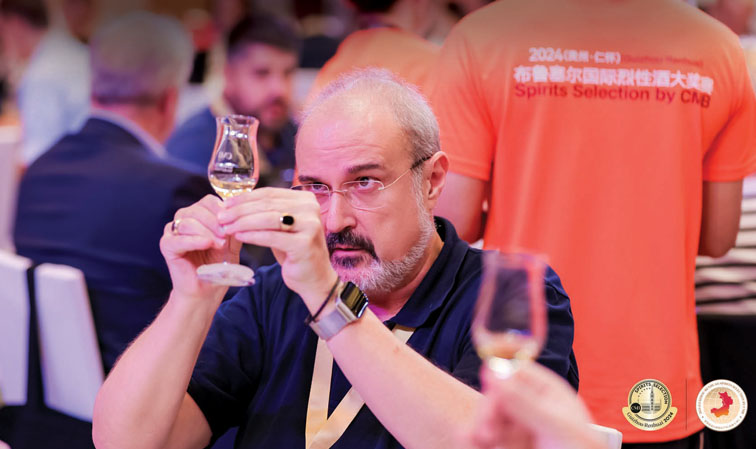
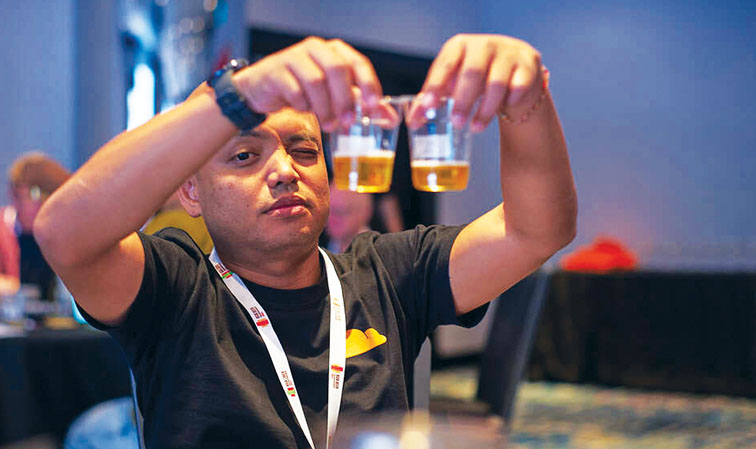
In September this year, I was in Jalisco, Mexico, to represent India as part of an international pool of 140 experts. We had to blind-taste and judge no fewer than 2,590 spirit samples from 70 countries. The judging process, I can attest, is highly rigorous. I was also judge at CMB’s Spirits Selection in Renhuai (China) last year.
The jurors were organised in groups of six each at a table with a chairperson, Vicente Ribeiro, a Cachaca producer from Brazil. The others were a rum producer from Martinique, a drinks journalist from Canada, and the General Manager of a Tequila distillery.
When our table had completed judging each flight, all our scores were visible to the chairperson, who quickly helped arrive at a consensus on whether the highly scored samples were to be awarded silver, gold – or possibly even Revelation or Grand Gold.
No matter what our judgment might be, it could later be overruled by the technical committee because, under EU law, no more than 1/3 of the samples can be awarded a medal—a rigorous, well-structured process executed meticulously.
And I could well imagine the months of preparation for the judging, especially the work put in by Ulric Nijs, the Director of Spirits Selection, whose job was to ensure that flights were structured homogeneously within each category to minimize dissonance.
Asia Beer Championship
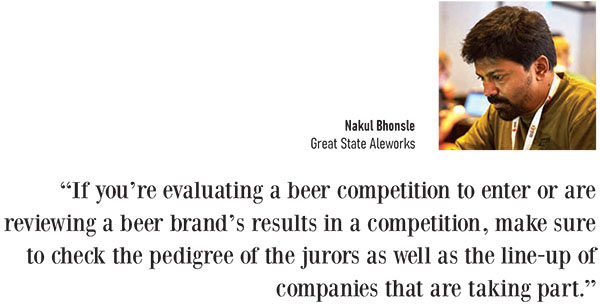
Nakul Bhonsle, founder of Pune-based Great State Aleworks, was recently in Singapore to judge the 2025 edition of the Asia Beer Championships. He joined a jury pool of around 50 judges – mostly from Asia, but some also from the US and Europe. Aditya Challa of Susegado Brewing (Goa) was the only other Indian juror.
The most crucial factor in evaluating a beer competition is the quality of the judges, Nakul says. This becomes a key criterion for deciding whether to enter a contest. At the Asia Beer Championship, the judges were a mix of certified beer judges with experience in various international beer competitions, global industry representatives, and professional brewers.
A fair number of the judges, whether brewers or non-brewers, have also earned key industry certifications from organizations such as BJCP, Siebel or Cicerone. What is more, some judges are so passionate about beer, the fly in at their own expense!
The second aspect, Nakul continues, is to look up who’s participating and who have been past winners. The Asia Beer Championships gets more than 700 entries from across the continent each year, with most of the top breweries participating. Sadly, only eight breweries from India participated this year. But India brought home three medals and two championship awards.
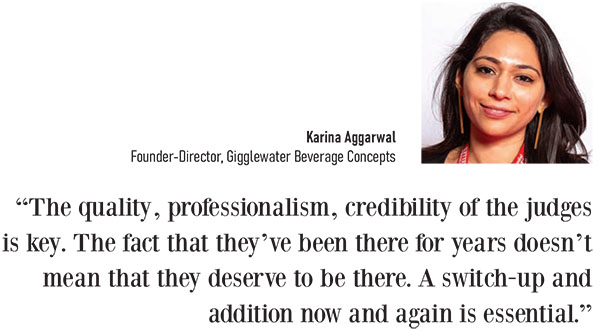
Nakul admires the process: with a total of 15 judging tables, the number of tables dedicated to a particular style depends on the number of samples received. The more samples of a specific style, the greater the likelihood that they will go through a multi-stage process: the first round, semi-finals and then the finals.
Each judge must write at least 50 words for the sample evaluated, so that competing breweries can receive tangible feedback that might influence changes to their recipes or processes. “A bigger motivation for me to enter a competition is to receive feedback after the event. It goes a long way in fine-tuning recipes and understanding nuances, something we don’t easily have access to in India,” says Nakul.
Other beer competitions that Nakul holds in high regard are the Australian International Beer Awards and the Great American Beer Fest in the US, to name a few.
Double-Check @IWSC
Madhu Rajigani, The Macallan Brand Ambassador-India has been a judge twice at the prestigious London-based International Wine and Spirits Competition (IWSC), in 2023 and 2025. His experience has been very positive, and the learnings have been immense.
In IWSC, as compared to Spirits Selection, judges are organised by category. In his first year of judging as a junior jury member, he was assigned to categories like liqueurs and fruit spirits. Subsequently, based on his earlier performance, he was allowed to join higher-prestige panels for categories such as Scotch whisky, world whisky and rum.
The jurors at each table are drawn from the production side, brand ambassadors, drinks media, seasoned bar owners and importers/ buyers. There is a lead juror for every category. This helps ensure that products are evaluated not only on technical aspects but also on how consumer-friendly they are.
After each flight, the assessment is discussed by the entire table, and any samples that need re-evaluation are addressed. If a sample is found worthy of a Gold or Double Gold status, then it is re-evaluated by another judging table! Judging goes on for a fortnight, with each juror spending an average of 4 days.
In Madhu’s opinion, there are many new competitions for spirit ratings that have shown great success in the medal positionings that they award. The winning brands utilise these awards within their marketing and media campaigns, which showcases just how meaningful such competitions are.
Judging The Jury
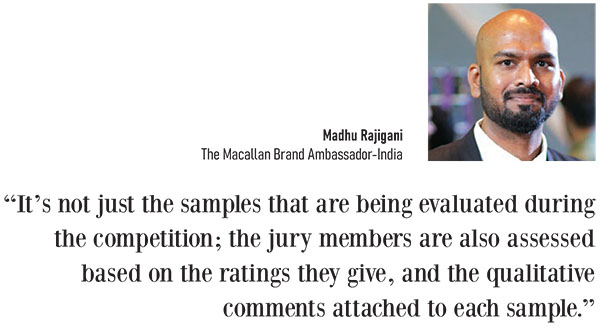
Madhu notes: “It’s not just the samples that are being evaluated; it’s also the jury members, based on the ratings they give, and the qualitative comments attached to each sample.”
Karina Aggarwal was 24 years old when she first sat on the jury at the Concours Mondial de Bruxelles hosted in Slovakia. As the youngest juror, she felt a mix of excitement and intimidation. She has gone on to judge various wine, beer and spirit competitions worldwide over the past decade.
First up, the judges. “It’s important to vet the judges and the judging. The panel needs to be diverse, with good representation of all palates and opinions – not just one ‘type’. Then there’s the “production and rhythm of the judging”: the room, sounds, temperature, service efficiency.
Equally important is the discipline in adhering to time, spitting when required, treating fellow judges with respect, and producing serious tasting notes. Finally, the scoring parameters. How well is the sheet designed to give a good representation of what you are tasting?
“Over the course of the year, the marketing of the award, building value for the badge – and not feeling the need to pander to everyone – is important,” Karina emphasises.
True Credibility
According to Rojita Tiwari, judge at International Sugarcane Spirits Awards, Sake Selection, Spirits Selection by CMB and CMB Wine Awards, a credible competition features an eclectic panel comprising experts from various countries, regions, and specializations, ensuring a well-rounded evaluation.
Then comes the core of any competition: its intent. Does it aim to identify and genuinely reward the best products in each category? Or is it more focused on awarding nearly every participating product? Transparency in this regard is crucial, she stresses.
Rojita also assesses the organisers’ commitment to supporting winning brands beyond the award ceremony. Do they offer ongoing services, marketing support, or promotional opportunities?
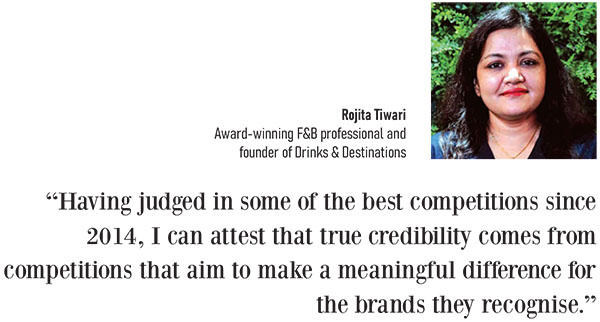
“Having judged in some of the best competitions since 2014, I can attest that true credibility comes from competitions that aim to make a meaningful difference for the brands they recognise,” she signs off.
Just as we ask bartenders to always look behind the label to understand the liquid in more detail and the brand, it is also essential to look behind the award or at least ask the right questions when you’re told about one.