








The global spirits landscape has undergone a radical shift, and 2025 has proven to be a landmark year for Indian malt distillers. For decades, the Indian whiskey market was synonymous with ‘Indian made foreign liquor (IMFL) – largely molasses-based spirits flavoured to mimic grain whiskey – or expensive imports from the Scottish Highlands.
However, a profound cultural and industrial maturation has solidified. Driven by a “drink less but better” philosophy, a surge in “vocal for local” national pride, and a sophisticated new generation of consumers, Indian single malts are no longer just alternatives; they are the gold standard.
This transition, from a bulk producer of value spirits to a world-class creator of artisanal malts, marks the most significant evolution in the history of Indian distilling.
The year 2025 saw a notable trend: a strong preference for domestic single malts rather than international alternatives. Throughout this year, Indian single malts extended their lead, with domestic brands now consistently outperforming imported counterparts in sales volume.
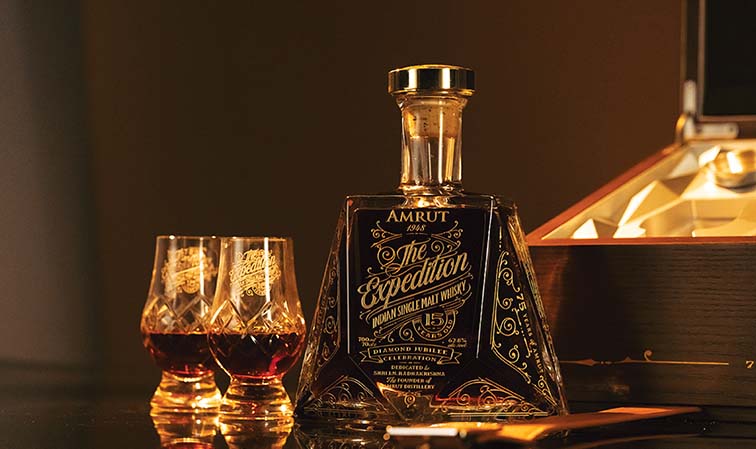
By the end of 2024, Indian malts had already secured more than 50% of the market, and in 2025, this gap had widened further as consumer trust reached an all-time high. Esteemed brands like Amrut, Paul John, Rampur, Indri and Godawan remain the top five best-selling labels, proving that world-class spirits are being crafted on Indian soil.
UNIQUE TERROIR
A key element contributing to the success of Indian distillers remains the distinctive Indian terroir. In contrast to Scotland’s cool and moist climate, India’s tropical warmth and elevated humidity greatly speed up the maturation process.
This results in a powerful interaction between the spirit and the wood, enabling a whiskey to achieve a depth of flavor and character in just a few years that would take decades elsewhere.
The “angel’s share” (the quantity of whisky that evaporates) continues to average between 8% and 12% each year in India, while in Scotland, it remains around 2%. This rapid aging process enhances flavours in a shorter period, giving Indian malts a bold and robust character.
Furthermore, the use of indigenous six-row barley, which has a higher protein and enzyme content, provides a bolder flavour profile with distinct grassy and citrus notes, compared with the lighter notes typical of Scottish two-row barley.
FLAVORS AND FINISHES
In 2025, distillers have boldly expanded their approach beyond conventional aging techniques, embracing local ingredients and innovative finishes. This trend has created flavour profiles that are both exotic and familiar, offering a unique blend of flavours.
Brands are now firmly established in “terroir-driven” expressions. The Indian single malt category has also seen a growing interest in cask finishing and cask-swapping techniques with producers across the spectrum, including Amrut Distilleries, John Distilleries (Paul John), Radico Khaitan (Rampur), Piccadily Agro (Indri) and Diageo India (Godawan).
Alongside this, there has been exploration of native botanicals and regional ingredients at various stages of production, reflecting an effort to express local character without departing from established single malt conventions. This has allowed Indian distillers to carve out a distinct niche, establishing a unique identity that no longer merely replicates the Scotch tradition.
Looking ahead to 2026, the Indian spirits market is anticipated to reach new heights of premiumization, with the introduction of even more high-priced, luxury product lines.
In the past few years, premium whiskey accounted for only a small part of the market. By the end of 2024, it represented more than 21% of total sales volume. This trend continued to rise into 2025. Today’s consumers, particularly millennials and Gen Z, view whiskey as a full experience rather than just a drink.
This group is keen to explore the deep history and craftsmanship that each bottle represents. As a result, distillers are focusing on limited-edition releases and high-end products that attract a global community of enthusiasts who appreciate the story and origin behind their drams.
GLOBAL FOOTPRINT
Indian malt whiskey is no longer a domestic secret; it is a global export powerhouse. Indian whiskey exports are on the rise, with manufacturers now exporting single malts to over 60 countries, duty-free shops, and global retail outlets. This global expansion is supported by consistent international acclaim.
For instance, at the 2025 World Whiskies Awards, Indian brands dominated key categories: Indri won ‘Best Indian single malt’ for its Founder’s Reserve, while Amrut’s Peated single malt (cask strength) secured a Gold medal.
At the 2025 International Whisky Competition (IWC), Diageo-India’s artisanal single malt, Godawan, continued its winning streak with double Gold honors at the 2025 Monde Selection, Rampur’s Jugalbandi #6 was recognised as the ‘Best World single malt’ at the John Barleycorn Awards, and Paul John’s Oloroso select cask won the Gold medal at International Spirits Challenge in 2025.
PROMISING OUTLOOK
The way whiskey is purchased in India has undergone a significant transformation due to the maturity of e-commerce and changes in urban demographics. Online platforms have removed the constraints of traditional retail, allowing consumers in Tier-II and Tier-III cities to access premium malts. While Tier-I cities previously held most of the market share, smaller towns and regional hubs are now emerging as important centers for both production and consumption.
Digital marketing and online stores allow for detailed product comparisons, creating high demand for rare or limited-edition bottles that were previously unavailable in local liquor stores.
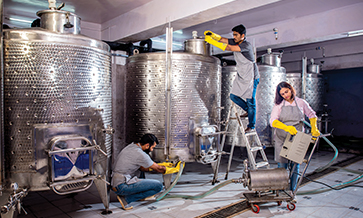
The outlook for Indian malt distillers is very promising. The market value is set to hit US$25.7 billion by the end of 2025 and the volume growth is expected to rise to 541.02 million cases by 2034. Considering this sustained demand, top companies are further boosting their production capabilities.
For instance, major players have recently doubled their capacity and barrel stocks to meet global interest. Industry experts predict that as we move toward 2030, India will not only lead its own ‘Single Malt Revolution’ but is also on track to become one of the top three global producers and exporters of whiskey.
Although regulatory challenges remain, the path forward is evident. India has revolutionised the global whiskey landscape, emerging as a top producer and exporter that garners respect from enthusiasts around the globe.