








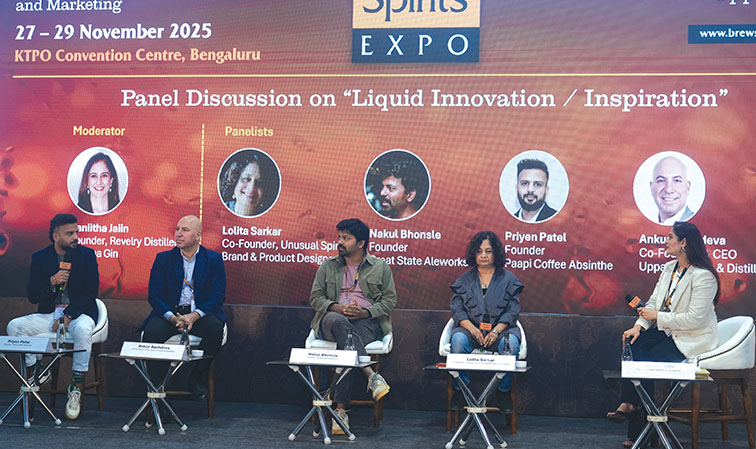
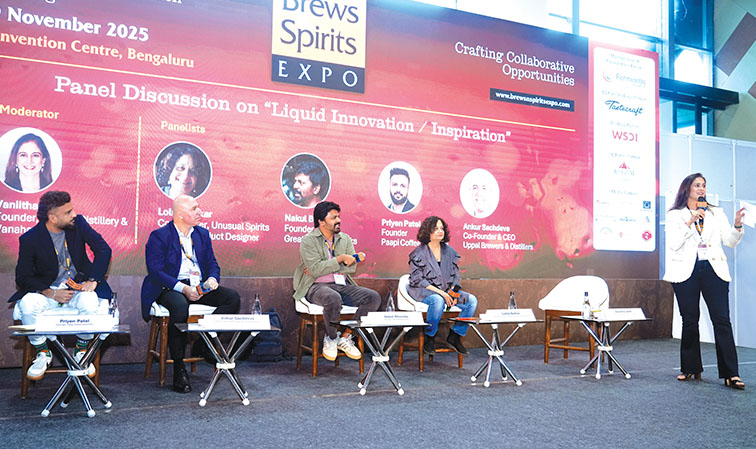
The panel discussion on ‘Liquid Innovation and Inspiration’ explored the evolution of the Indian craft spirits and beer industry, focusing on how Indian terroir and local ingredients are being reimagined by a new wave of entrepreneurs.
Moderated by Vaniitha Jaiin (Founder, Revelry Distilleries), the panel featured Lolita Sarkar (Unusual Spirits), Nakul Bhonsle (Great State Ale Works), Ankur Sachdeva (Uppal Brewers and Distillers) and Priyen Patel (Craft Alcobev).
The discussion highlighted a shift in the Indian market where consumers, particularly Gen Z, are increasingly confident in local flavours and “Indian pride”.
Defining inspiration: For some, inspiration is derived from filling market gaps, such as the reintroduction of absinthe, a category that was largely absent or prohibited for a century. Others view it as a drive toward conscious drinking, where the liquid’s story and ingredients take centre stage.
Role of terroir: Terroir is central to these new brands. For example, Lolita Sarkar uses Gondhoraj lemons from Bengal (Limoncello 24) and strawberries from Mahabaleshwar (Fragoncello 412) to create liqueurs that mirror European quality using Indian fruit.
The panelists detailed specific breakthroughs in crafting “proudly Indian” spirits and beers:
- 100% millet-based beer: Nakul Bhonsle shared how Great State Ale works moved from using imported malted barley to researching and launching a beer made entirely from local millets like jowar and bajra.
- Indian absinthe: Priyen Patel described a two-year R&D process to source ingredients like wormwood, hyssop and chamomile from Uttarakhand. A significant technical challenge was achieving the ‘louche’ (the cloudy effect when water is added), which required six months of experimentation with terpenes and fennel extraction.
- Premium Indian whiskey: Ankur Sachdeva emphasised moving away from borrowing global brand names and instead using an “Indian grammar” to create whiskies like Soorahi and Madhvan that are tailored for the Indian palate and cuisine.
The panellists debated the best approach to innovation:
- Concept first: Ankur Sachdeva argued that innovation should start with a clear philosophy or concept rather than just asking ‘what can I add to this blend?’ He also noted that while creativity is vital, it must achieve market performance, likening a creative failure to an Indian art film failing at the box office.
- Experimental freedom: In contrast, Nakul Bhonsle noted that the craft beer industry’s small-batch systems allow for “throwing things in” to see what works, encouraging collaborative experimentation.
- Agility vs. legacy: Large legacy companies are now attempting to innovate by launching super-premium products, but they often struggle to manoeuvre, like a giant ship. This has led to the acquisition of smaller founders whose product-market fit is already established.
The session concluded with an ingredient showdown, identifying several elements underutilised in the Indian industry:
- Cashew fruit: Highly aromatic and often discarded everywhere except in Goa.
- Toddy varieties: Indigenous alcohols from coconut, palmyra, date and fishtail palms that have the potential to be bottled and premiumised, similar to trends in Sri Lanka and the Philippines.
- Rice: Noted for its versatility in local beer, its potential for a larger-scale rice wine (sake) industry, and its use as a base spirit (ENA) for gins like Vanaha.
To understand the current state of Indian liquid innovation, think of it like a chef transitioning from a fusion menu to a traditional one. For years, the focus was on adapting global recipes to local tastes, but now, the industry is looking into its own “pantry” of indigenous grains and botanicals to create something entirely original that no longer needs to mimic the West to be considered premium.