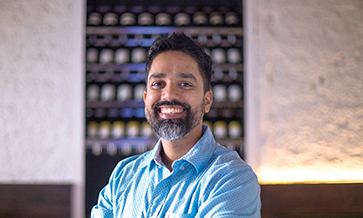









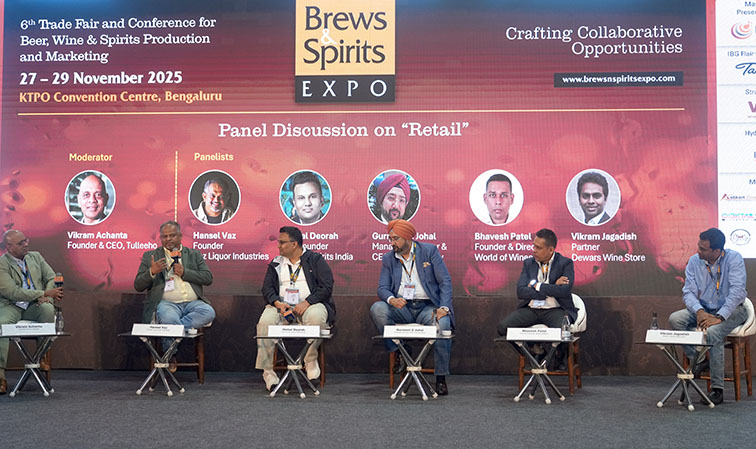
The panel discussion on ‘Beverage Retail’ was moderated by Vikram Achanta and featured Hansel Vaz, Founder of Vaz Liquor Industries; Vishal Deorah, Co-Founder of The Whiskey Company; Gurmeet Johal, Managing Director & CEO of GD Alcobrew: Bhavesh Patel, Founder & Director of the World of Wines; and Vikram Jagadish, Partner at Dewars Wine Store.
The Indian alcobev retail landscape has changed significantly, moving from traditional over-the-counter formats to large, walk-in stores. This shift is supported by changing government laws that allow for longer-term planning, moving beyond a 1-year mindset to a multi-year strategy.
The new generation of retailers is increasingly focused on professionalising the industry, including a greater emphasis on staff training to ensure frontline employees understand the categories and brands they sell.
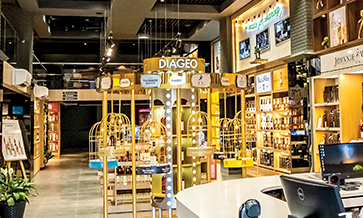
A central theme of the discussion was the brand overkill seen in many large retail shops, where displays are dominated by large multinational corporations.
- Rental model: In high-cost markets such as Gurugram, retail is often treated as a real estate play. Retailers may charge for shelf space by the square inch, using brand marketing budgets to recoup high license fees and operating costs.
- Consumer perspective: Panellists argued that brand-dominated sections (a store divided by manufacturer, rather than spirit type) can confuse the customer who must go hunting for a specific category.
- Sectional planography: To combat this, some retailers are moving toward sectional layouts, grouping all gins, tequilas, or wines regardless of the brand. This approach favours storytelling around categories rather than just logos.
- Support for craft: Smaller craft brands often struggle to compete for shelf space against large companies with massive marketing budgets. Some retailers attempt to balance this by offering a three-month trial period for new products to see if they can speak for themselves through sales.
Retailers are seeking ways to provide curated experiences to build customer loyalty, though policy environments regarding in-store consumption vary by state. In some regions, retailers have created dedicated tasting rooms or wine clubs to foster a community of serious enthusiasts.
Panellists emphasised that staff must be educated to provide value; if a salesperson cannot explain a product beyond their personal preference, the customer experience suffers.
In markets where direct in-store tasting is restricted, a hybrid ‘bring your own bottle’ model has emerged. Customers move to an attached drinking joint with live music and food, allowing brands to legally sample products through promoters.
Despite the push for better consumer experiences, the financial pressure on retailers remains high due to low margins and humongous license fees. For many, the support from large brands is essential to survive. Finding a balance between brand-led financial support and a consumer-led shopping purpose is the retail sector’s greatest challenge.